And so am I…
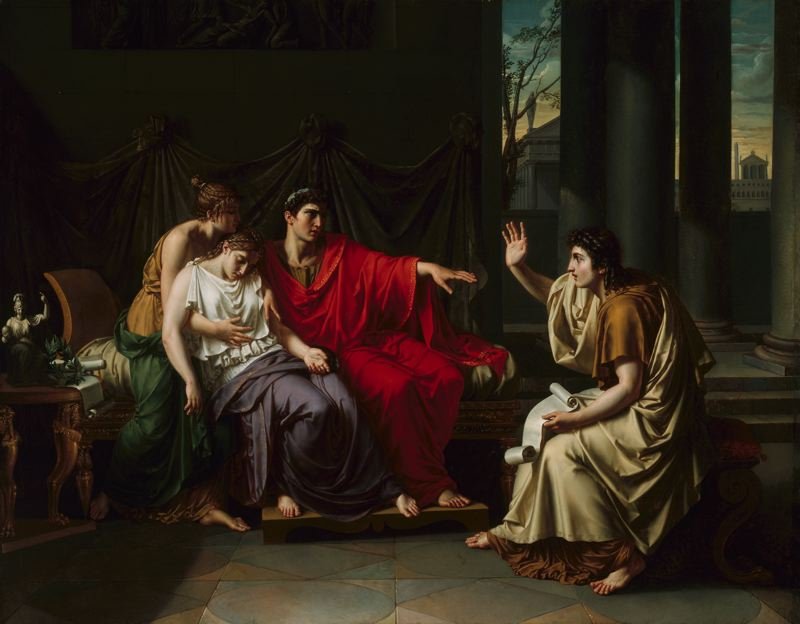
Virgil Reading the “Aeneid” to Augustus, Octavia, and Livia (Jean Baptiste Joseph Wicar, 1790/93)
…Till Homer’s ghost came whispering to my mind.
He said: I made the Iliad from such
A local row. Gods make their own importance.
– Patrick Kavanagh, “Epic”
The world is smaller. It’s both cliché and not to point out how the technological leaps of the last hundred years have brought the vast majority of the human race into much closer contact with itself. Gone, at least until commercial space flight is a thing, are the years of lonely travel over wide, empty spaces; the induction into foreign, mysterious cultures; and the intoxication of true discovery.
Not only smaller, but also diminished the world’s aura of mystery. Nearly everything is online, documented, and quickly disproven or doubted. Almost every nook and cranny of human experience has been converted into 1s and 0s, a digital banality that makes one hope the singularity never occurs.
But honestly, this mode of thinking—which I slip into when feeling pessimistic—is also a product of our 21st century smallness, of our inability to see what’s beyond the screens upon whose surfaces our eyes are constantly skating. The world only feels small because we can no longer see it. We’re blind to the fact that the fabric of epic and universal experience is woven with the threads of particular human lives. Our lives.
This idea has never presented itself so forcefully as it did this last week, while reading the Irish poet Patrick Kavanagh. His poetry, built out of personal experience in rural Ireland, is earthy and richly textured. It reaches for the rhythms of peasant life, specifically Irish peasant life, and elevates it into an archetype for human experience.
Within the pastures of Irish rural life, beneath the “triangular hill that hung / Under the Big Forth,” the farmers and laborers of Kavanagh’s poetry strive and struggle against the woolen hood of poverty’s ignorance, yearning for something, something they can’t understand, something that exists both within them and beyond them and regretting that “the Maker of Light had not touched [them] more intensely.”
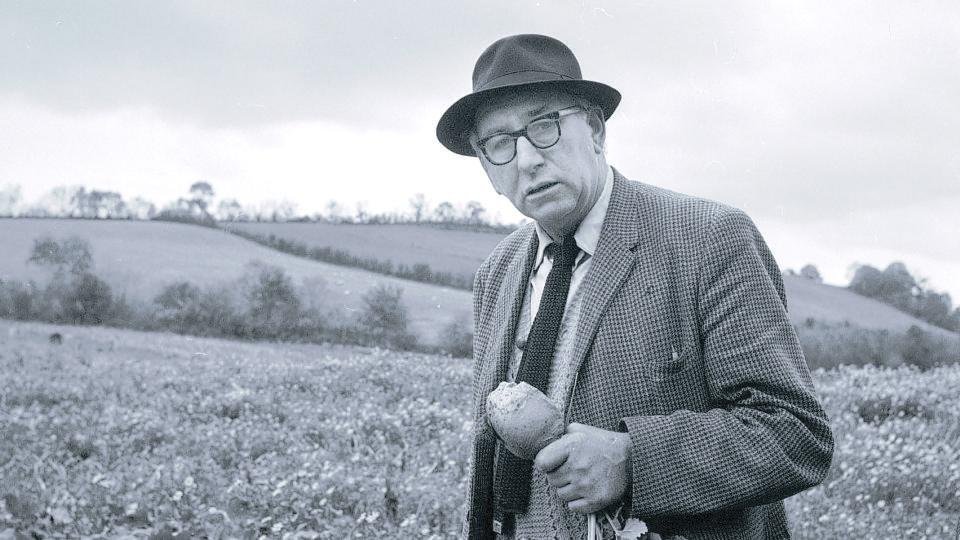
Poet Patrick Kavanagh
Kavanagh, through is personal experience in rural Ireland—he grew up in a farming household—invites the reader into the peasant’s world, shows them how built from the same material as as that of distant legends. The ultimate lesson (if you want to call it that) of Kavanagh’s poetry is that the universal exists within all of us, that the legends of old only became so after being pressed tight by the weight of time. That they are no different than us.
Our own stories, our feuds and our loves, our tragedies and our victories, carry the same emotional weight as those tales of Beowulf, Achilles, and Gilgamesh. The old epics are alive in us because they are us. Despite our technological trappings and the ridiculous mantle of civilization we ostentatiously wear, we are, fundamentally, made of the same flesh as all who have come before us.
I’ll finish with this. In his non-fiction, which is littered with the wisdom of ages, Argentinian writer Jorge Luis Borges points out that:
“Whatever one man does, it is as if all men did it. For that reason, it is not unfair that one disobedience in a garden should contaminate all humanity; for that reason it is not unjust that the crucifixion of a single Jew should be sufficient to save it.”
And this:
“I am he as you are he as you are me
And we are all together” – The Beatles
 Tyler Abbott
Leave a reply to Alan Cancel reply