On suffering and the creative process
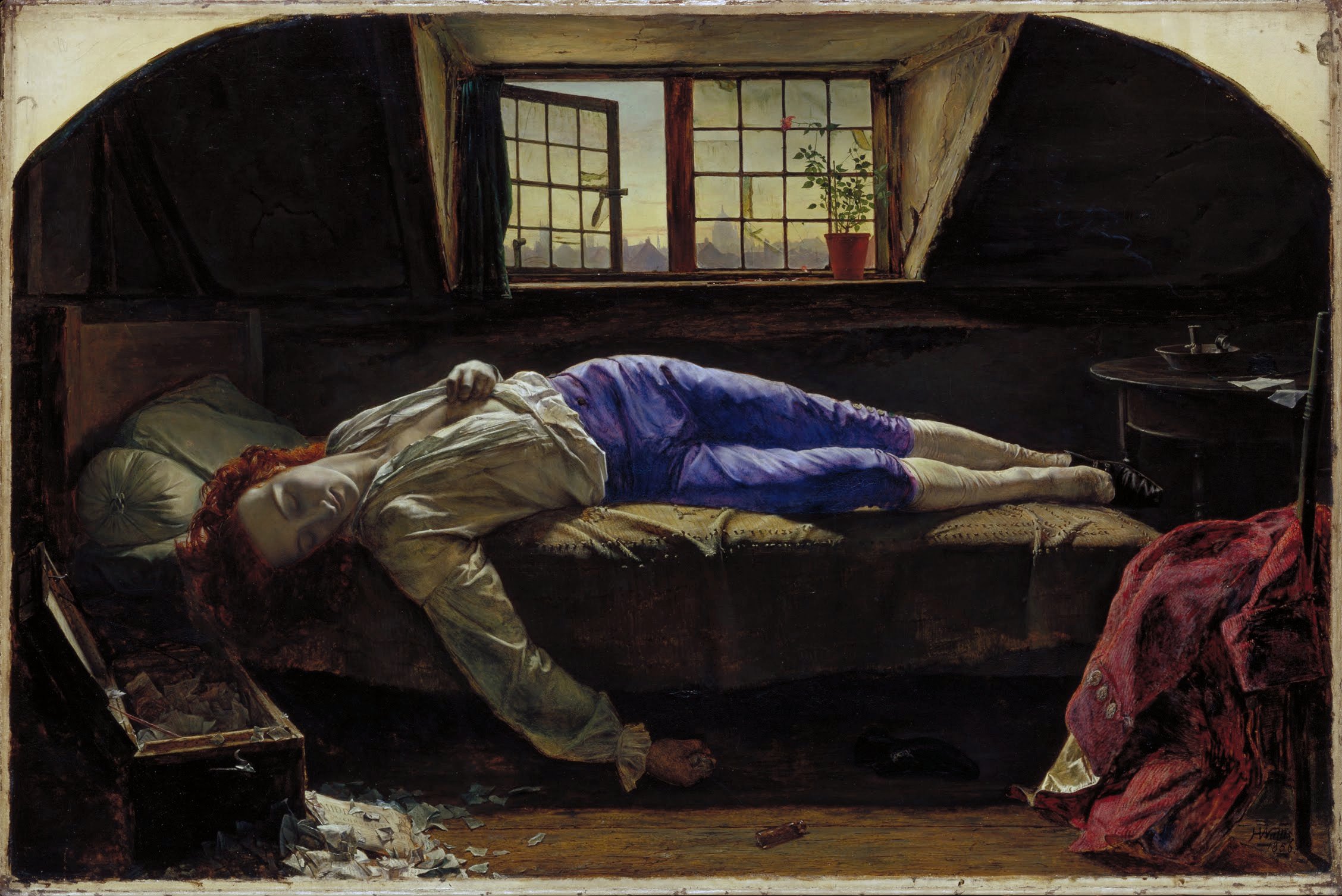
“The Death of Chatterton” by Henry Wallis
“Minor authors—who lived, men knew not how, and died obscure, men not marked when.” – Roger Ascham.
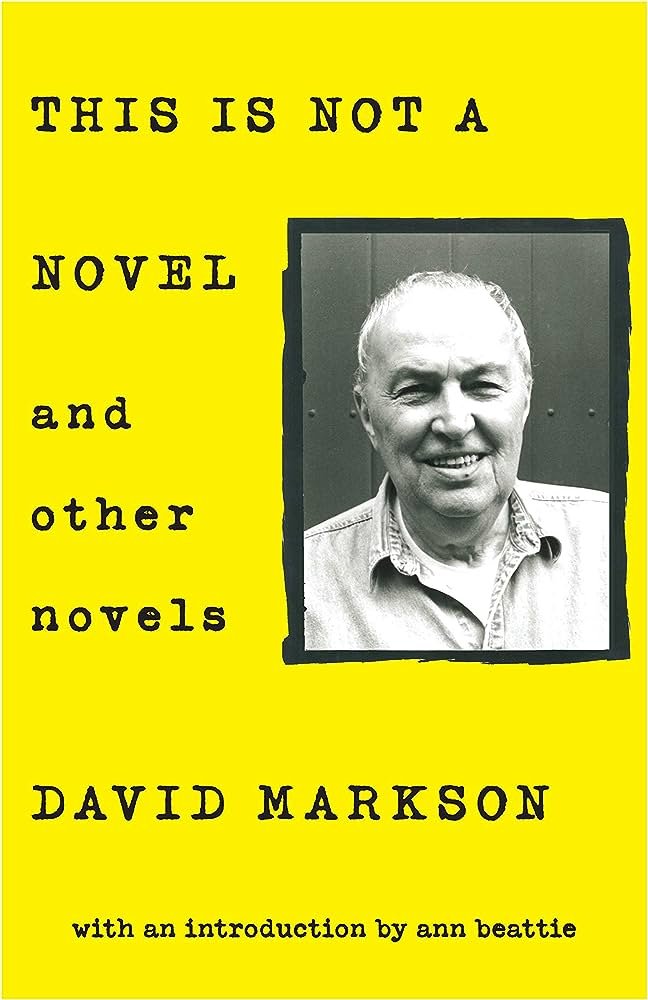
A series of “novels” I return to again and again are David Markson’s three final works: This is Not a Novel, Vanishing Point, and The Last Novel. Most famous for his earlier novel Wittgenstein’s Mistress, which was highly lauded in a review by David Foster Wallace, Markson was an experimental writer who documented better than anyone else I know the human cost of art.
Unfortunately, most folks have never heard of Markson, and despite his towering stature as one of America’s greatest experimental authors of the past century, he died in June of 2010, 82 years old and relatively unknown. His personal library, according to his own wishes, was donated to the Strand bookstore in NYC and was gradually discovered and documented online (unfortunately the site that hosted photocopies of his marginalia is no longer live).
I return to these “novels”—and why I put novels in quotes will be obvious soon—quite frequently because they document, through a long series of brief quotations, notes, and observations, the misery of genius and examine, without flinching, the human cost of creation.
The unnamed narrator of the “novels” weaves together a vast tapestry of the trials, struggles, and poverty that undergird the experience of the artist in western culture. For example:
“Paganini died of what was evidently cancer of the larynx.”
“Boccacio’s last years were spent in enervating poverty. In his will, Petrarch left him his own best heavy coat with which to confront the Tuscan winters.”
“Moliere died after bursting a blood vessel in a convulsive tubercular coughing fit and choking on his own blood.”
“Renoir, well into his forties and still impoverished. So thin it wrung your heart, a woman friend remembered.”
“Beethoven died of dropsy, after having gone through pneumonia and jaundice.”
These are pulled basically at random from This is Not a Novel and Other Novels, which compiles Markson’s final three works into a single volume. There are many more and it’s easy to get lost in the maze of seemingly quotidian details about the lives of the West’s greatest artists.
But why, you might ask, do I return to such bleak reading again and again? The answer: I’m fascinated and perplexed by the cost of creation, by the suffering that great artists squeeze from themselves in order to produce something valuable, and, ultimately to confront the question: is all that suffering worth it?
Honestly, I don’t know. That’s why I keep coming back.
I’m not a great artist. I have pretensions—like anyone who can write, draw, or sculpt with even average ability—but I have no expectation that I’ll produce the 21st century’s Ulysses or In Search of Lost Time. I don’t know if I would be willing to put myself and my family through the misery necessary to create a truly great work. The thought of foisting a life of poverty and privation on them while I try to eke out a living writing stories or novels that would most likely never be appreciated seems, to say the least, selfish and cruel.
And I doubt I’m alone in feeling this way.
Our current culture is flooded with the language of therapy. Personal well-being, for better or worse, has become the highest state-of-being which a human can achieve. We are less concerned, overall, with how far we can push ourselves in the realms of human achievement and more focused on creating safe spaces in which we can thrive, all the while setting complicated boundaries between ourselves and others in order to avoid even the faintest whiff of toxic behavior.
And despite the comfort and security this generates for many individuals, I can’t help but feel that it’s not conducive to the type of sacrifice and suffering that have produced man’s greatest achievements.
But whenever I think to long on this subject, whenever I wax poetical about the valor and virtue of suffering for one’s creations and achievements, a doubt arises:
Are these achievements even worth it?
Shelley’s poem Ozymandius sum’s up the fate of all our works:
I met a traveller from an antique land,
Who said—“Two vast and trunkless legs of stone
Stand in the desert. . . . Near them, on the sand,
Half sunk a shattered visage lies, whose frown,
And wrinkled lip, and sneer of cold command,
Tell that its sculptor well those passions read
Which yet survive, stamped on these lifeless things,
The hand that mocked them, and the heart that fed;
And on the pedestal, these words appear:
My name is Ozymandias, King of Kings;
Look on my Works, ye Mighty, and despair!
Nothing beside remains. Round the decay
Of that colossal Wreck, boundless and bare
The lone and level sands stretch far away.”
And Schopenhauer, always the pessimist, reminds us that: “Time is that by virtue of which everything becomes nothingness in our hands and loses real value.”
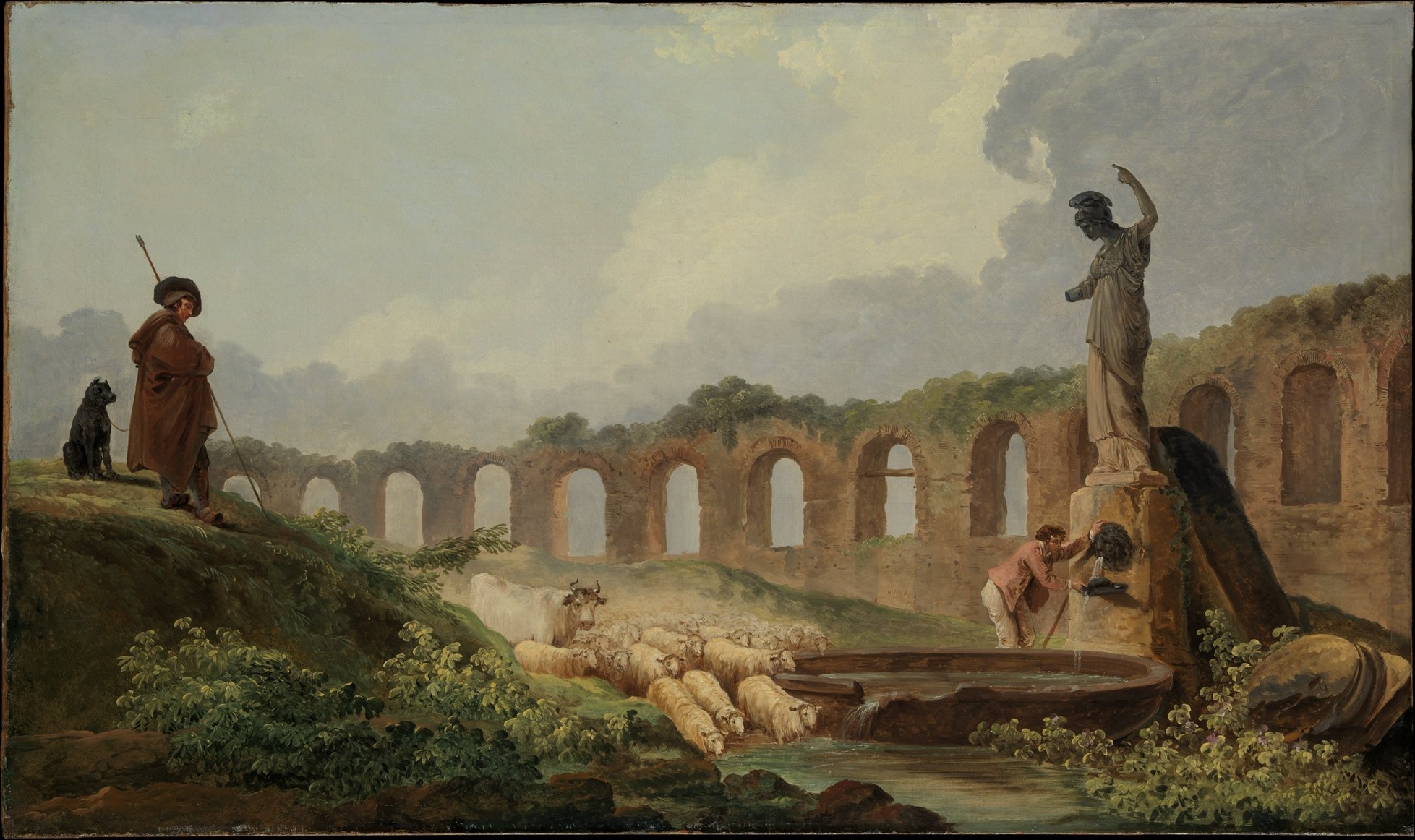
Hubert Robert’s “Aqueduct in Ruin”
In the end, in spite of all our strivings—our sacrifices and self-care—we pass into dust. Time swallows us whole and after a few generations—if we’re lucky—we’ll be remembered by a select few of our descendants.
So, I guess that might be my way of saying, spend your time how you want to spend it. If you want to wrap yourself in the comfort of self-fulfillment, then so be it.
And if you want to eke out a meager existence while writing the next Finnegan’s Wake, then do that instead.
But I can’t help but feel that whatever we choose, there will be some moment, either at the end of—or after—this short existence, in which realizing we are nothing but the sum of our days, we will be forced to reckon with how we spent our time and who we became.
Choose wisely.
 Tyler Abbott
Leave a comment