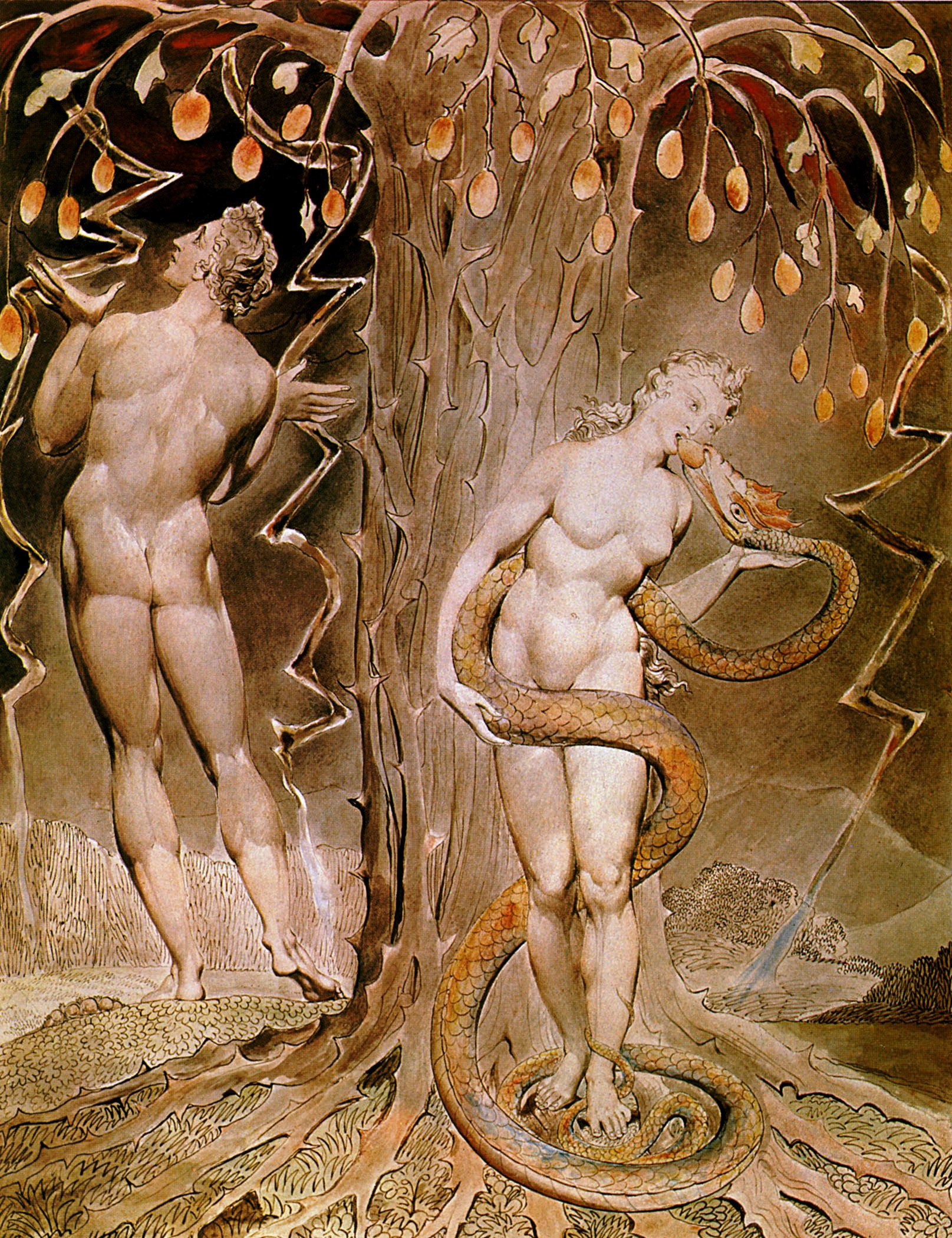
The Temptation of Eve, by William Blake
So the Lord God said to the serpent, “Because you have done this,
“Cursed are you above all livestock
and all wild animals!
You will crawl on your belly
and you will eat dust
all the days of your life.
And I will put enmity
between you and the woman,
and between your offspring and hers;
he will crush your head,
and you will strike his heel.”
Genesis 3:14-15
I’ve been thinking about snakes, and it’s hard not to wax biblical when thinking about snakes.
In the Judeo-Christian tradition, they’re the ancestors of our mortal enemy—the embodiment of Satan, the great deceiver. The whispering of a snake started a chain reaction of agency that sent humankind careening out of the garden, clothed and chastised, forced to live by the sweat of their brow. In other words, every trial and travail we face in life is because a distant ancestor, theologically speaking, took the advice of a snake.

Interestingly, in eastern philosophy, the snake holds an equally important, but less infamous place. In Hinduism, snakes are associated with Shiva, and are seen as symbols of power, destruction, and transformation. Shiva wears one around his neck, signifying his control over the deadliest of creatures.
In Buddhism, the snake is a protector, an entity imbued with wisdom. In one story from the life of the Buddha, it’s said that a snake protected him from a storm while he peacefully meditated. The snake can also represent the transformative cycle of life, shedding its skin and being “born anew,” a biological metaphor for the transformative potential within us all.
It’s remarkable that the symbolism surrounding snakes varies so widely across the globe, with it being reviled or revered depending on the culture and set of beliefs. Like many critters, it holds a place of importance in the American psyche, both positive and negative. For several Native American tribes, like the Navajo, Cherokee, and Lakota Sioux, the snake is a creature to be feared, sometimes associated with witchcraft and destruction, even playing important roles as evil monsters in their mythology.
On the other hand, the Hopi and Pueblo peoples reverenced the snake, associating it with fertility and water, with the Pueblo performing a biennial Snake Dance to pray for both water and fertility. The ceremony involves handling live snakes, sometimes even venomous ones, and releasing them to carry messages to their ancestors.

[Hopi snake priest with snake in his mouth in the Hopi Snake dance] / Hartwell & Hamaker, Phoenix, Ariz.
Snakes have been on my mind because, today, I mortally wounded a small garden snake. The little guy was coiled at the base of a tree, hidden in the tall grass where I couldn’t see him. By the time he was whipped into the edger, it was too late. I let go of the trigger-lever and shouted incoherently, stunned.
Mel hurried over, thinking I’d hurt myself. Worse, from her perspective as a vegetarian, I’d apparently killed the tiny creature, hardly a footlong.
She picked it up and laid it out on the patio table, trying to figure out what to do with it next. While she and our daughter examined it, it took a shuddering breath and began to writhe, having only been stunned by the whirring wire of the edger. It clearly wouldn’t survive, so I took a hammer and mercy-killed it.
We buried it in the garden, behind the green bean trellis.
Better, we figured, than tossing it in the garbage can.
While I finished edging and mowing the lawn, I reflected on the death of the snake, and my role in its demise. Aside from one or two fish, my experience with killing animals is fairly limited. I felt bad, disturbed by the part I played in nature’s grand drama.
Death is, of course, inevitable. I’ve written here before about my own experience coming to term with life’s hard stop. But to take another creature’s life, that’s something different. Even though it was “just a snake”, and only minutes before I’d been stalking the yard with a can of bug spray trying to kill wasps, I felt a sharp sense of guilt.
Throughout this experience, I’ve kept coming back to a parable, or Nyaya, from Vedantic philosophy called Rajjusarpa Nyaya, or The Rope and the Snake. In the tale, a man is traveling alone at night, along a dark road. Ahead, he catches a glimpse of something in the middle of the road. It appears to be a coiled snake. In horror, he turns and flees, afraid that it might be venomous. The next morning, he returns to the road and finds that it wasn’t a snake at all, but a pile of coiled rope.
The moral of the story, if you haven’t figured it out, is that our senses often deceive us. What, in one instance, may appear to be deadly could, in fact, be harmless when examined more closely. We have no way of knowing, most of the time, whether our first impression is the right one. And even then, it’s possible that we’re mistaken many times about something before finally gathering enough evidence to discover its true nature.
But for that little snake, none of that mattered. He was alive, quietly minding his own business, before I violently eviscerated him with a weedwhacker. And worse, the weedwhacker only stunned him, and for 90 horrible seconds—the time it took for me to find a mallet—he writhed in agony before I smashed flat his head, a sickening experience I don’t care to repeat.
I’m struggling to make sense out of the violence I accidentally inflicted on that snake, how out of an idyllic afternoon, pain and death could rear their heads. I don’t know if I can squeeze any sort of meaning out of its death. In some ways, I can’t help but feel that our universe, even created (somehow) by a God—as I believe it to have been—is mostly indifferent to us.
It’s a universe that exists, in its fallen state, in what Werner Herzog called a “harmony of overwhelming and collective murder.” A seemingly endless chain of horrendous violence, committed by every creature, great or small, against one another until we’re visited by whatever eschatological end awaits us.
But despite this, our universe is a beautiful place. Somehow, the sublime and the vile manage to coexist.
 Tyler Abbott
Leave a comment