My daughter, who is only 3 1/2, has recently developed a nearly obsessive fear of death. She brings it up all the time. She is terrified of growing up, getting old, and dying. Sometimes she doesn’t want to eat because she knows that it will help her “grow up.” Tonight, we sat next to her bed and cried together while she said, “Dad, I just want to be a kid, I just want to be a kid, I don’t want to die.”
And what do you say to that? You can explain religion, you can pin your hope on Christ, an afterlife, a good cause or something greater than yourself. But when you’re 3 years old, none of that makes much sense. It’s too big. Too broad and conceptual. But death. One minute you’re there, and then you’re gone. Everyone understands that. It’s an instinct, evolutionarily bred into us to keep us safe. Fear = Death. Death = Fear. The two exist hand in hand for most people. But how do I teach her not to be scared of death? No one taught me. I had to learn.

Bruegel’s The Triumph of Death
Around 1562, Pieter Bruegel the Elder painted The Triumph of Death, a panoramic oil on canvas masterpiece depicting humankind overwhelmed by the forces of death. Like a zombie film. But real. Hordes of skeleton overcome all humankind. Men and women, rich and poor, young and old. Death triumphs over all of them. And if you look carefully, you’ll notice that nearly everyone is either afraid of death or oblivious to its presence. Many try to run or hide. Some try to fight. All succumb in the end. The painting’s message is blunt. Death is coming for you, it says to the viewer, and it’s not wrong. The vast majority of people who have seen this painting since it’s creation have been swallowed up by death while the painting itself, and its vivid representation of mortality, still stand.
Bruegel’s masterpiece, and its inexorable message, are, for me, a memento mori. For a long time, I kept a small detail from the painting as my phone background, so that I could see it whenever I unlocked my cell. I’ve reproduced it below.
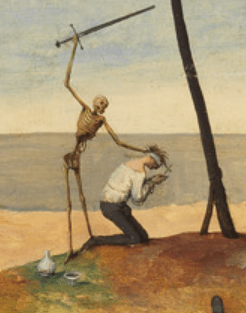
I’ve studied this painting quite a bit and as far as I can tell, this is the only figure in it that is aware of death’s presence but not frightened by it. The reason, I believe, is because he is prepared. For Bruegel that clearly meant religious preparation. The soon to be executed man holds a cross and prays. Near him are the eucharistic offerings. He is prepared for death. He accepts it. Unlike all the other figures in the painting who fight, hide, or remain oblivious to death, this single lone figure accepts his fate and has prepared himself for it.
This painting, this small detail from this 400 year old Dutch Renaissance masterpiece, changed my life, changed how I saw death and how I contemplated the end of my earthly existence. And it’s done so in a way that’s hard to articulate. No longer do I fear death, other than the occasional pang. Instead, it has become a goad. A constant prodding to do more, to learn more, to be better. Because death is coming. No one escapes and no one knows when there time is up.
But how do I communicate that to a 3 year old? Can I? I don’t think so. I think she has to learn for herself. I can prepare the groundwork. I can teach her any and all of the philosophical and theological systems that we use to put distance between ourselves and death but, in the end, she’ll have to learn for herself how to live knowing that life has an expiration date.
 Tyler Abbott
Leave a comment