We are all complicit.
Why do people have to live outside
We have the resources
We have the means
Why
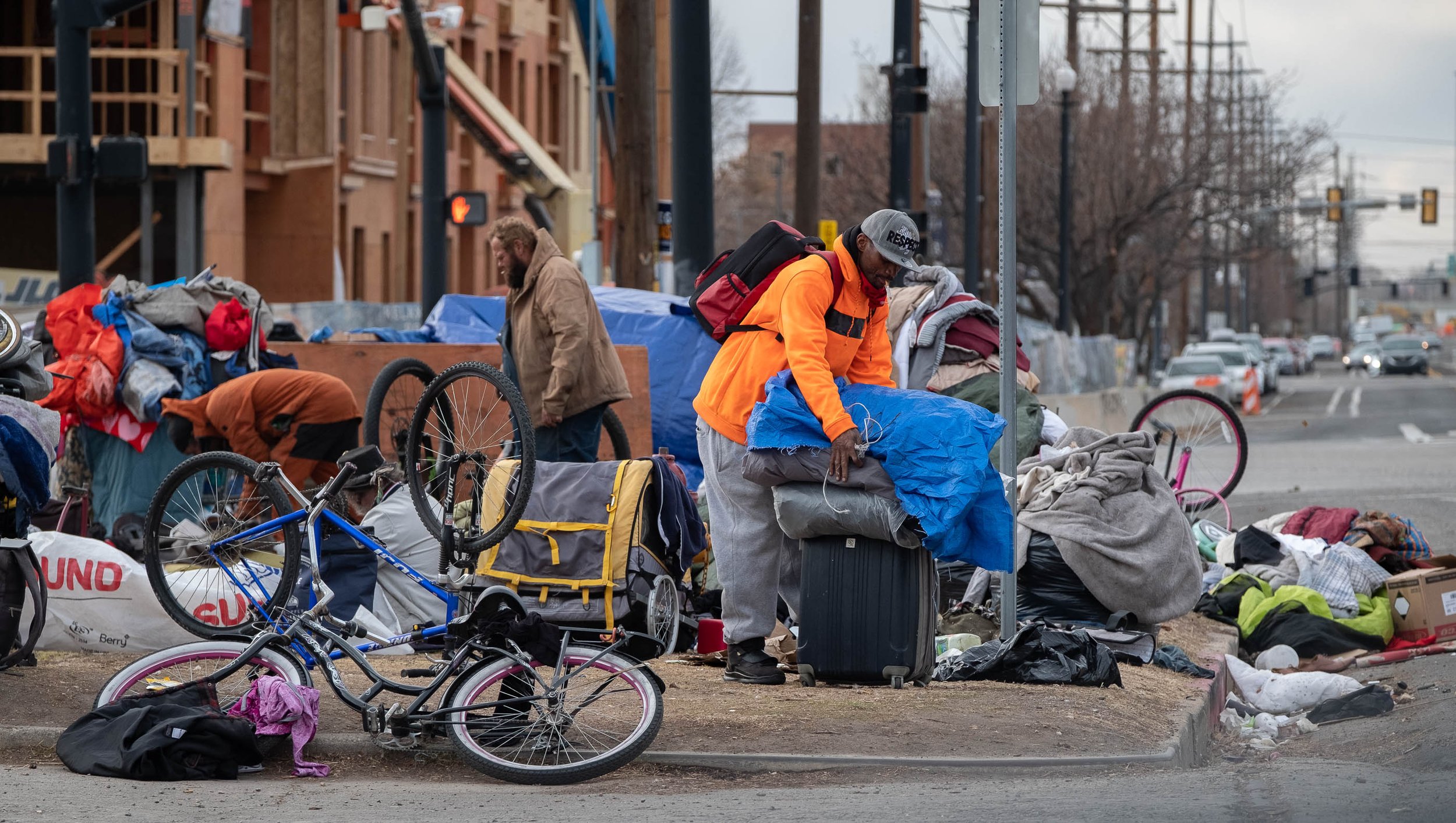
Francisco Kjolseth | Salt Lake Tribune
You don’t have to go far in Utah to find a homeless person (If you’re bothered by my use of the term “homeless,” I’ll cut you off right here. Read this newsletter by Freddie Deboer and you’ll get an idea of how the replacement for homeless, “unhoused,” is a semantic band-aid that allows us to talk about homelessness without hurting our own feelings). Once a “downtown” problem, you only need to head to your nearest underpass, busy intersection, or grocery store parking lot, to find ragged individuals touting cardboard signs whose scrawled messages are meant to illicit our (typically financial) support.
I know you’ve noticed them. Stripped of dignity and reduced to begging. Young and old. Male and female. Every ethnicity.
Homeless individuals differ from the rest of “us” by a mere accident of birth. The wrong genes. The wrong household. The wrong parents. The wrong circumstances. We look away, breathe a sigh of relief, and think, “glad that’s not me.”
But it could be you. You may think you’ve worked hard to get where you’re at now, and you probably have worked hard, but you’re only one poor childhood, one mental illness, one serious accident away from the same plight that affects over 87,000 individuals in our state. A majority of us are closer to the gutter than we are to the top.
Each year, our state’s homelessness problem appears to be getting worse. You don’t have to cruise the streets of SLC or its surrounding environs to encounter homeless people. However, if you’ve been into the city recently, you’ll know how bad the problem has become.
A couple times a month, I take my daughter up to SLC for different activities. Recently, we went to a model train show at the Utah Fairgrounds. Afterwards, we had lunch in downtown SLC and then drove east through the city to the Utah Museum of Fine Arts. Without passing by any of the typical “homeless” spots in the city, we encountered encampments under overpasses and in empty lots. We saw an elderly man on a corner, filthy and ragged, sucking oxygen through a machine. Behind a shuttered pizza restaurant, we saw two men huddled up together before one staggered over to the sidewalk, pocketing a syringe. Drugs and poverty in the heart of Zion.
I don’t think you can pin the homeless situation in Utah down to any one cause. Currently 87,000 or so homeless people literally roam the streets, some temporarily housed in shelters, others completely unsheltered. Think about that number for a moment. 87,000 people is more than the combined capacity of Rice-Eccles Stadium and the Vivint Arena.
Most are single adults, but a not disproportionate amount are youth or families. Families with children. Children who do not have a home to go to at night. Who do not have their own bed, their own toys, their own place of safety. That we allow this, especially in the state with the second strongest economy in the Union, is a blight on our humanity. Worse, It is evil.
And what are we doing? Individually, not much. Collectively, a bit. We let our tax dollars do our work for us, trusting that our state government (who has gloated about how well it hands off welfare to the Church of Jesus Christ of Latter-Day Saints (LDS)) can fix the problem. But our state government is no different than we all our individually. Hardly anyone has the appetite to help our homeless. Hardly anyone is willing to roll up their sleeves and work with the meek, humble, and downtrodden of our society. It’s easier to thank the heavens for our blessings and bury our heads in the sand.
But let me be clear. I condemn all of us, even myself. Whether a member of the state’s majority religion or not, we are all failing. If we do not care for the least among us, then we are no longer a society, becoming instead an atomized, alienated mass of individuals whose lives are increasingly “solitary, nasty, brutish, and short.”
In the Book of Mormon (I include this not to beat you over the head with religion but because it articulates what I’m trying to say so adroitly that it can’t go unmentioned but skip it if you feel like it), in what might be it’s most profoundly radical verses, King Benjamin, in his farewell address to his people, says:
13 And ye will not have a mind to injure one another, but to live peaceably, and to render to every man according to that which is his due.
14 And ye will not suffer your children that they go hungry, or naked; neither will ye suffer that they transgress the laws of God, and fight and quarrel one with another, and serve the devil, who is the master of sin, or who is the evil spirit which hath been spoken of by our fathers, he being an enemy to all righteousness.
15 But ye will teach them to walk in the ways of truth and soberness; ye will teach them to love one another, and to serve one another.
16 And also, ye yourselves will succor those that stand in need of your succor; ye will administer of your substance unto him that standeth in need; and ye will not suffer that the beggar putteth up his petition to you in vain, and turn him out to perish.
17 Perhaps thou shalt say: The man has brought upon himself his misery; therefore I will stay my hand, and will not give unto him of my food, nor impart unto him of my substance that he may not suffer, for his punishments are just—
18 But I say unto you, O man, whosoever doeth this the same hath great cause to repent; and except he repenteth of that which he hath done he perisheth forever, and hath no interest in the kingdom of God.
19 For behold, are we not all beggars? Do we not all depend upon the same Being, even God, for all the substance which we have, for both food and raiment, and for gold, and for silver, and for all the riches which we have of every kind?
20 And behold, even at this time, ye have been calling on his name, and begging for a remission of your sins. And has he suffered that ye have begged in vain? Nay; he has poured out his Spirit upon you, and has caused that your hearts should be filled with joy, and has caused that your mouths should be stopped that ye could not find utterance, so exceedingly great was your joy.
21 And now, if God, who has created you, on whom you are dependent for your lives and for all that ye have and are, doth grant unto you whatsoever ye ask that is right, in faith, believing that ye shall receive, O then, how ye ought to impart of the substance that ye have one to another.
22 And if ye judge the man who putteth up his petition to you for your substance that he perish not, and condemn him, how much more just will be your condemnation for withholding your substance, which doth not belong to you but to God, to whom also your life belongeth ; and yet ye put up no petition, nor repent of the thing which thou hast done.
23 I say unto you, wo be unto that man, for his substance shall perish with him; and now, I say these things unto those who are rich as pertaining to the things of this world.
24 And again, I say unto the poor, ye who have not and yet have sufficient, that ye remain from day to day; I mean all you who deny the beggar, because ye have not; I would that ye say in your hearts that: I give not because I have not, but if I had I would give.
25 And now, if ye say this in your hearts ye remain guiltless, otherwise ye are condemned; and your condemnation is just for ye covet that which ye have not received.
I quote at length because these words apply to all of us who consider ourselves members of the majority religion in Utah. God condemns those who have and do not give to the poor. It is that simple. There can be no excuse, no victim blaming, no weaseling out of our covenants.
Similar language can be found in the New Testament, the Old Testament, and the Quran. Secular humanist and atheist philosophers have echoed these same sentiments without couching them in theological terms.
Whatever angle you take, we are failing. By allowing so many of our brothers and sisters, fellow human beings, even children, to suffer miserably day in and day out, we are complicit in a horrendous evil that blights are civilization.
You might say I’m naïve or stupid (and I might be). You may say that homelessness is complicated. That it requires x amount of money or y legislation to solve. Or that chronically homeless people just want to be homeless (read the above quote if this is your feeling). It’s possible you’re right.
But, eventually, statements like these become excuses to do nothing—to accept the status quo. Worst of all, I have no solutions to present after such a lengthy diatribe. I have no answers to the questions I’ve posed. Just anger. Anger that I’m not doing more. Anger that you aren’t doing more. And anger at the grinding poverty we close our eyes to each and every day.
 Tyler Abbott
Leave a reply to Alan Cancel reply