
It’s the year 2024 and, despite millennia of overuse (and mockery , the plot twist just isn’t going away.
We honestly just can’t seem to get enough of it.
To give you a bit of context (hopefully you don’t need it), the plot twist is a narrative device that’s practically as old as the art of storytelling.
From the ancient Greek play, Oedipus Rex, and the story of Paul on the road to Damascus, all the way up to the almost universal twists and turns that form the bread and butter of prestige television and film, the twist—or peripeteia, as Aristotle called it—has allowed creators to subvert their audience’s expectations.
But what’s the point of subverting audience expectations?
Well, fundamentally, it’s because we as an audience are cynical. We’ve seen it all. We can predict the ending of a movie or novel based on the first few minutes or chapters. The love interests end up together, despite the obstacles that we know will be surmounted. The hero will prevail, despite it appearing like he’s down or out.
These tropes are deeply ingrained in our storytelling subconscious. Most recently, in the film Dune 2, much of the film’s tension boiled down to a knife fight between the sinister Austin Butler character and Chalamet’s Paul Atreides. But, despite the filmmaker’s best intentions, we knew the outcome of the fight before any blood was even drawn.
The plot twist then functions as a system reset. Something happens we don’t expect and we’re forced out of our conventional viewing habits and opinions. We need to actually think about what’s happening on the screen or page. New neural pathways are forged and story we’re being told becomes instantly more memorable.
Another question: how does this relate to marketing and advertising?
A brand is a story–and now in many cases, stories are brands–and when the story gets old, sometimes it needs a twist, a shot of adrenaline to re-engage it’s audience. This is not unlike the shocking reversals of daytime television where a dead inexplicably returns, shocking the audience and deepening the drama.
In many instances, though, a brand needs to stand out among a near-infinite sea of look-a-likes. So, ad campaigns driven by narrative twists can hook themselves in the viewer’s mind by creating unique connections.
These ads sometimes outlive their original intent. Enter: Man fights bear.
Now, I know you’ve seen this ad, either when it originally aired or as an internet meme.
But, before you watch it, can you remember what it’s selling?
My first thought was beer. Because, obviously, alcohol is one of the few substances on earth to make fighting a bear seem like a good idea.
So, watch:
Salmon.
Did you remember that?
But you remembered the ad.
Why?
Because it shocked. It surprised. Maybe it made you laugh out loud.
But this can go terribly wrong. Sometimes what people expect from a story or brand is comfort.
Take, for example, the most recent Star wars trilogy. It’s a case study in brand subversion and audience expectations.
J. J. Abrams, with his movie in that trilogy, broke no new ground. The Force Awakens basically rehashed the main plot points of a New Hope and, not surprisingly, most audiences, including the core star wars die-hards, ate it up.
But then came Rian Johnson’s The Last Jedi, a film hellbent on turning the Star Wars canon on its head. The result: an artistically interesting film that alienated it’s core audience, damaging the Star Wars brand and sinking the trilogy of which it was a part.
It’s a fine balance, then, deciding when and how to subvert audience expectations. Why does your audience engage with you? Is it because they know exactly what they’re going to get and want only that?
Many people watch cooking shows because they know what they’re going to get. Despite having had the same format for over a decade, Chopped is still going strong. They don’t need to change up their formula. If they did, maybe throwing in some wacky, over-the-top reality TV elements, they’d probably upset their core audience and lose viewership – a death sentence today when so many brands are vying for our attention.
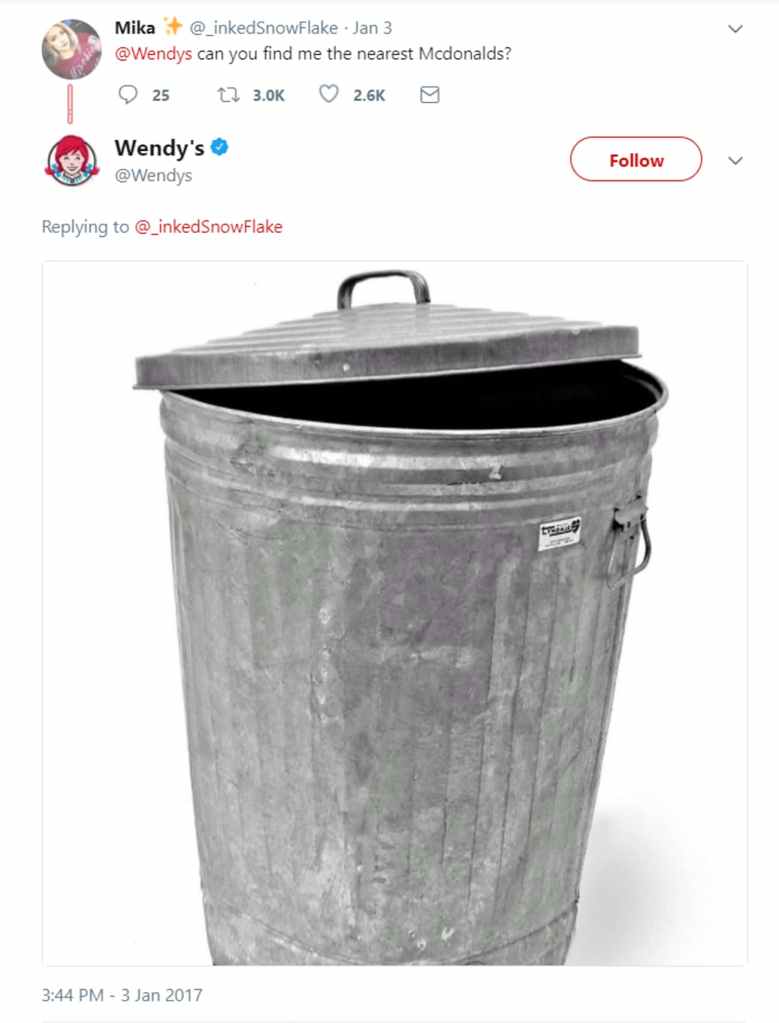
On the other hand, twists can make an audience care about a brand they perhaps viewed indifferently. For example: Wendy’s. A middling fast-food brand, Wendy’s has always struggled to distinguish itself from the many fast food joints that dot the American landscape. But by pushing the boundaries of corporate edginess with it’s online presence, Wendy’s subverted our expectations for how a brand should act.
To wrap it up, you should always be gauging how your audience feels about you. Why do they come to you? If they’re getting what they want, then changing it up may be a mistake, but if you’re just one brand among many, with little to differentiate your product offering from the competition, then, a little plot twist might just raise your profile.
 Tyler Abbott
Leave a comment