
“There is a direct line that runs from the medieval instruments of torture, via the industrial movements of production-line work, to the techniques of schooling the body by using mechanical apparatuses.”
– Jean Baudrillard, Vanishing Point
On the recommendation of some folks that I work with, I recently began listening to a book by Nassim Taleb. He’s written quite a few “important” books on randomness, fragility, and being a “sucker,” but, because I’m lazy, I opted for his slim book The Bed of Procrustes, a short volume of philosophical aphorisms and meditations. It’s an interesting read. Sometimes profound, sometimes scathing, and nearly always funny.
He’s down on quite a few things, mostly economists and those who work for a living, but he also is quite scathing about the gym. Serendipitously, I was at the gym while listening to the book, thus engaged in the sort of behavior that Taleb finds, maybe not deplorable, but, at a minimum, repugnant. This, of course, got me thinking about how we perceive the gym and what purpose it serves in modern (American) society.
Before we dive in, here’s a quick history lesson on gyms:
The history of the gymnasium can be traced back to ancient Greece and Rome, both of which built gymnasiums as not only places of exercise but as institutions for art, education, and social discussion. A temple to the mind, body, and spirit, so to speak.
Funnily enough, the word gymnasium comes from the Greek word “gymnos” meaning naked, because gyms were a place where people exercised in the nude.
Gyms fell out of favor in the Middle Ages as time for leisure evaporated and most individuals spent the majority of their lives just trying to survive. No one wants to work on their squat after a 14-hour day of hard labor.
Cue the Renaissance: increased wealth, which led to an increase in leisure time for select portions of society, meant that intellectual interest could be directed back towards the body. A quick survey of Renaissance art makes clear that the elites of the time thought deeply about the human form—its proportions and shape—along with its relation to both the physical and divine worlds.
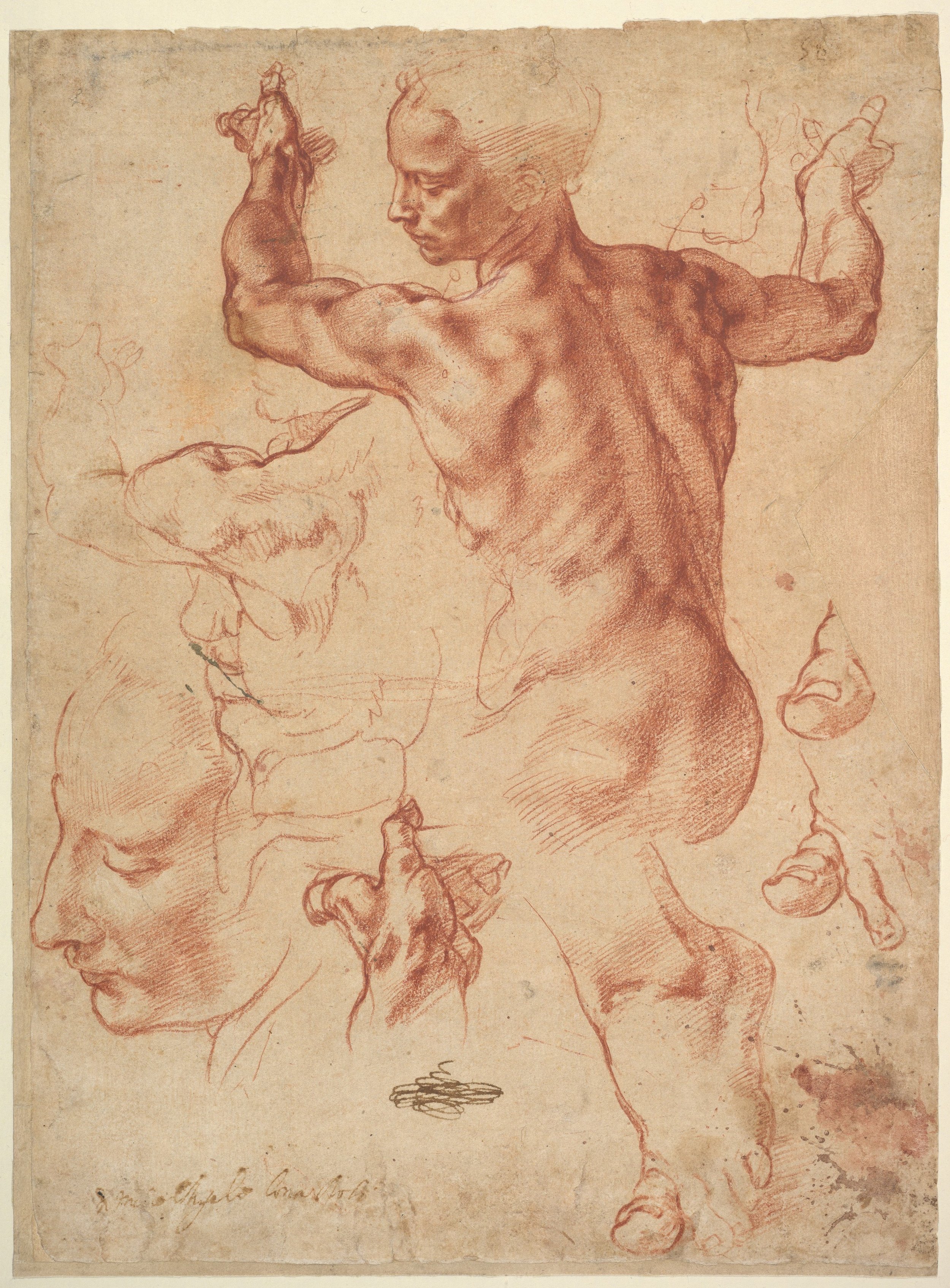
Studies for the Libyan Syble (recto), Michelangelo, 1510-1511
Since then, as life has grown more sedentary for ever increasing portions of the population, interest and use of gyms has increased, to the point that they’re now more frequently encountered than churches (a return to ancient times, perhaps).
Gyms, and fitness, are so universal, at least in the U.S., that you could say we are a culture obsessed with fitness. Our smartwatches and phones have numerous tools for tracking our health. We seek out ergonomic solutions to correct our monkish postures, and we track and gamify everything we do to optimize ourselves. These observations aren’t new. In fact, they’re some of the main (cliched) talking points in the backlash against fitness culture, a backlash that includes such trends as going “goblin-mode” or smoking cigarettes.
To come back to Taleb, he sees our obsession with the gym as another flattening of authentic life by the great commodifier: Modernity. He would, I imagine, see the transformation of the gym as a place for physical, mental, and educational learning to a place of merely physical improvement, as a symptom of modernity’s shallow obsession with the self. Taleb would have us be like the ancients, for whom physical fitness was a byproduct of an eudaimoniac life. Instead, fitness is the purpose of much of our lives.
I’d be remiss, I think, without mentioning Jean Baudrillard’s book Vanishing Point. Baudrillard was a French critical theorist, a thinker who was deeply concerned with modernity’s replacement of authentic life with various simulacra. Despite not often being attributed to him, his thought has sunk deep into our mental landscape through the cultural touchstones like the Matrix Films and theories about life as a computer simulation.
In Vanishing Point, Baudrillard tours America, fascinated and repulsed by our “hyperrealism,” our reality that has transcended the real and become a simulated version of it. That’s obtuse, I know, but, at its core, Baudrillard sees America as a place which has become obscured by the “idea of America,” an idea formulated and calcified by our almost complete immersion in visual media.
In this meandering work, Baudrillard touches multiple times upon the American obsession with exercise. He ponders the jogger on the beach, whom he compares to the primitive who, “when in despair, would commit suicide by swimming out to sea until they could swim no longer.” The jogger, he says, “commits suicide by running up and down the beach.” Baudrillard sees the jogger, the bodybuilder and the dieter as emblematic of the “cult of the body,” a cult which he considers youth-obsessed, death-averse, and “a new form of voluntary servitude.”
And that’s all pretty interesting: both Taleb’s disdain for gyms as a degeneracy of ancient Greek and Roman culture (a culture which, by the way, was only possible through extensive slavery) and Baudrillard’s theory that our cult of the body is a simulated, hyperreal (thus not authentic) focus on “life.”
BUT, and this is a big but, I think they both miss the point here even though I don’t think either of them are wrong. In fact, I think there are merits in both theories, but they are theories posited by someone who has not spent time training in a gym.
I’m no gym rat, not by any means, but I’ve been lifting weights regularly now for over a year, for 3-5 hours a week. Not a ton, but WAY more than the average person. I’ve watched and felt my strength increase. I’ve been amazed at my newfound ability to push myself, to develop greater discipline and control over not only my body but also my mind. The gym has become a forge, a place to develop what Henry Rollins called “the iron mind.”
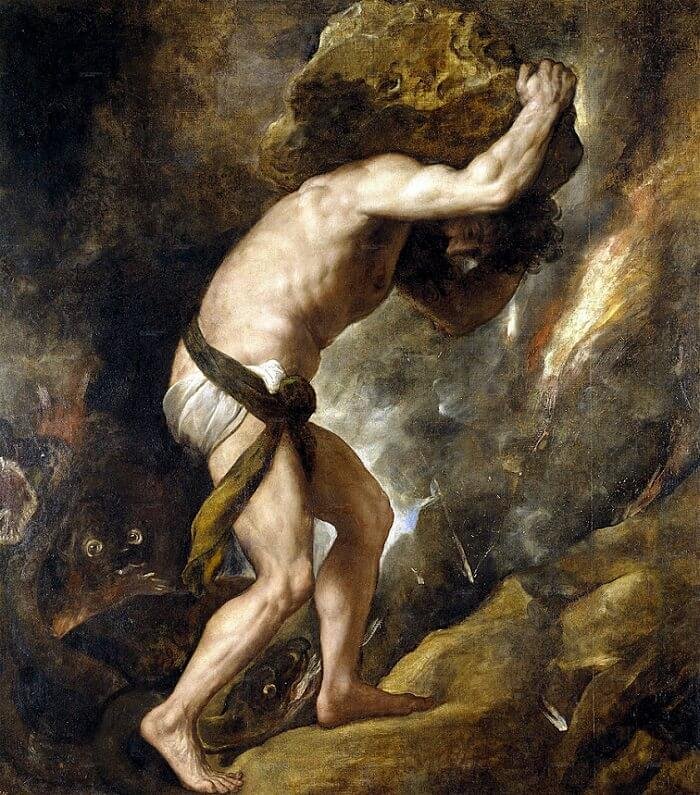
Sisyphus, Titian, 1548
Pitting one’s body against seemingly immovable and inhuman forces—the iron of the gym, the pitted concrete of the road, the shifting sands of the beach—is to partake in the deeply human experience of “struggle.” To struggle against forces which we cannot see, understand, or seemingly move.
Pumping iron is Sisyphus-ean. It has no end, no finishing line. There is no point at which you are “finished” lifting weights, or “done” running. Each workout only prepares you for the next. Each set is a precursor to that which will come after. Each mile is a prelude to the mile that follows.
Ultimately, death will put an end to this struggle, rendering it meaningless, but the very act of struggling, with the knowledge that death and time will erase our “gains,” is what makes exercise a deeply human activity and, inversely, rendering it meaningful.
 Tyler Abbott
Leave a comment